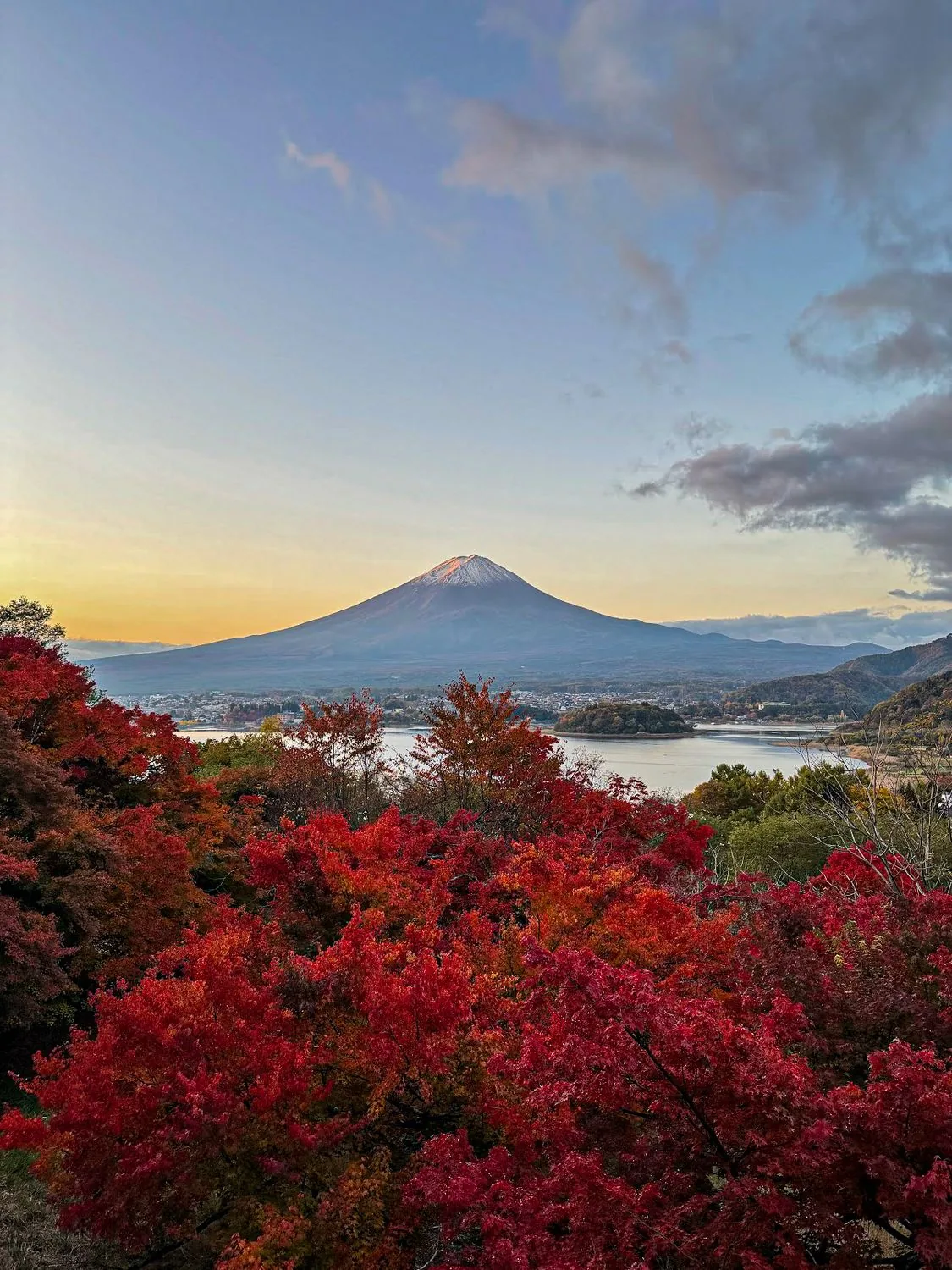
Should I visit Japan for cherry blossoms or autumn?
Choose the season for the overall trip you want, then treat the flowers or foliage as a possible highlight. Neither peak is guaranteed on a fixed date, and timing varies by place and year. Compare your date flexibility, preferred landscapes and tolerance for busy periods. Keep enjoyable indoor or city alternatives rather than building every day around a peak forecast.
Book autumn unless the blossom is specifically what you came for. Autumn foliage lasts roughly three to four weeks and is far easier to time; cherry blossom peaks for about one week and moves by up to ten days year to year. Autumn is also cheaper, less crowded and has more reliable weather. Blossom is more beautiful for the days it lasts — and you may miss those days entirely.
The comparison that matters
| Cherry blossom | Autumn foliage | |
|---|---|---|
| When | Late March – mid April | Mid November – early December |
| How long it lasts | About one week | Three to four weeks |
| Predictability | Poor — shifts up to 10 days | Good — moves slowly and steadily |
| Ruined by rain | Yes — one storm ends it | Barely |
| Crowds | Extreme, plus domestic travel | Heavy, but spread out |
| Hotel prices | Highest of the year | High, but lower |
| Book by | 9–12 months ahead | 8–10 months ahead |
| Weather | Cold mornings, changeable | Clear, dry, mild |
Why autumn wins for most people
It is far easier to time. Autumn colour arrives in Hokkaido in late September and reaches Kyoto in mid to late November, moving gradually. Anywhere in that window you will see something. Blossom gives you roughly seven days, forecast only a few weeks in advance, and a single day of hard rain can end it.
The weather is simply better. November in Japan is one of the most reliably pleasant months anywhere — clear, dry, and cool enough to walk all day. Late March is cold in the mornings and frequently wet.
It is cheaper and calmer. Blossom season combines peak international demand with domestic hanami travel and the start of Japan's fiscal year. Autumn is busy, but it is spread across a month rather than compressed into a week.
What each season is actually like
Cherry blossom
Genuinely one of the world's great sights, and completely unlike the photographs — it is a social season as much as a visual one. Parks full of people eating under the trees, shops selling sakura versions of everything, an atmosphere of collective good mood.
It is also the hardest week of the year to get a table, a room, or a quiet photograph.
Autumn
Quieter and, to many people who have seen both, more beautiful — the reds in Kyoto's temple gardens in late November are extraordinary, and they hold for weeks. Evening illuminations at temples are the highlight, and they run on a schedule rather than on luck.
The seasons nobody recommends, and should
- Late May — after Golden Week, before the rains. Green, warm, and remarkably empty.
- Early December — late colour in the south, winter illuminations, and the lowest prices of the good months.
- Late January and February — cold, but this is when snow monkeys, Hokkaido powder and the quietest temples happen, at a fraction of the cost.
If your dates are flexible and you are not chasing a specific sight, these three windows give you most of the beauty with none of the booking pressure.
What this means for booking
Whichever you choose, the constraint is the same: hotels and ryokan, not restaurants. A ryokan with private open-air baths may have twelve rooms in total, and in blossom or autumn they are gone six to nine months ahead.
Our booking timeline sets out what belongs at each stage.
Travelling in blossom or autumn?
These are the dates that need the most notice. Send me yours and I will tell you what is still realistically available.
Plan My Japan TripContinue planning: see the sample itinerary · planning scope and fees · How many days do you need in Japan? · A Japan Honeymoon Designed Around You.
How to use this advice
The route, pace and trade-offs here are planning suggestions from Juno Cox at Japan Travel Concierge by Juno. Match them to your own dates, interests and needs. Supplier opening days, fares, access, food requirements and reservation terms need separate confirmation for your trip.
Use these official references for current operator or destination information: JNTO: planning a trip · GO TOKYO · Kyoto’s official travel guide.
Keep planning: inspect the free sample itinerary. If the route still needs designing, ask about personalised planning; if it is already set, send the reservations you want help with.